Why sustainability is more than just a trend for us
A personal note on sustainability
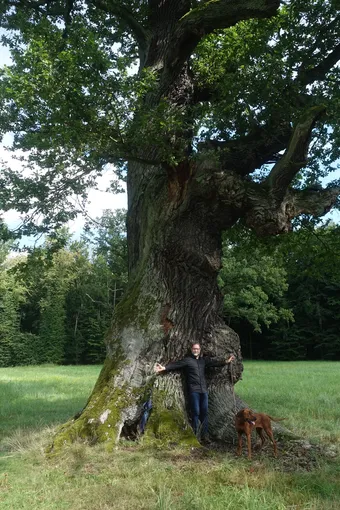
“For us, sustainability is not just a short-term trend. It is part of our DNA here in Chemnitz. As early as 1713, Carl von Carlowitz, who was born here, coined the term ‘sustainable forestry’. Without his foresight, Europe would look very different today. I am proud of these roots. But today it is no longer just about trees; it is about the global picture: CO₂, resources and our future.”
We won’t sugar-coat it: logistics consumes resources. Wherever internal combustion engines run, CO₂ is produced. We drive hundreds of kilometres every day across Germany and Europe. That’s our business, but it’s also our responsibility. Because every decision – whether it’s about choosing a vehicle, planning a route or selecting fuel – has a direct impact:
- To the air we breathe.
- To the towns we pass through.
- To the world we leave behind for our children and grandchildren.
For me, true sustainability rests on three solid pillars: the environment, the economy and social issues. The system will only work in the long term if we treat all three areas as equally important.
Here at ECL, we understand that sustainable logistics is not simply a tick-box exercise. It is a path that must be followed consciously and persistently. Step by step, journey by journey. I invite you to join us on this journey.”
Yours sincerely, Sebastian Fankhänel, Managing Director of euro.COURIER
Sustainability and economic efficiency are not mutually exclusive

From a potential analysis to the commercial exploitation of electric mobility, funded by the EU, 
From the preparation of our sustainability report right through to the energy management system in accordance with DIN ISO 50001, Texulting GmbH and its team led by Prof. Dr Markus Michael have supported us from the very beginning.
Updating our sustainability report in the coming years, documenting our progress in reducing CO₂ emissions and improving staff satisfaction are objectives that we will work towards in the future, in collaboration with Texulting.
We can already demonstrate that sustainability and cost-effectiveness are not mutually exclusive. Customers benefit in two ways: from the ESG rating within the supply chain and from cost-effective transport solutions.
Wir können bereits jetzt zeigen, dass Nachhaltigkeit und Wirtschaftlichkeit sich nicht gegenseitig ausschließen. Kunden profitieren in zweierlei Hinsicht: vom ESG-Rating innerhalb der Lieferkette und von wirtschaftlichen Transportlösungen.
Sustainability – Responsibility on the move
When you move goods, you take on responsibility. For us, that means we don’t just transport parcels from A to B. We pay close attention to HOW we do it – day in, day out, and journey by journey. Sustainability isn’t just a label for us; it’s part of our journey.
In doing so, we are guided by the three pillars of sustainability:
Environmental sustainability


Climate action
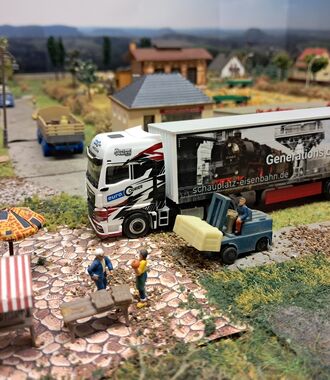
Immerse yourself in our interactive 360-degree panorama and explore the multifaceted solutions we have already implemented as part of our climate targets.
Our aim is to make our administration energy self-sufficient and our vehicle fleet climate-neutral within a few years.
Simply click and move the mouse, or click on the marked points.
Have fun exploring!
Full steam ahead with solar power – live data from our solar panel system
Since 2021, we have been generating some of our own electricity using our in-house photovoltaic system. In this way, we are not only reducing our CO₂ emissions, but also doing our bit for the energy and mobility transition – sustainability day by day, hour by hour as the sun shines.
Economic sustainability


Our path to sustainable logistics
For us, sustainable logistics begins with the question: “What can we do better?” Of course, our measures alone won’t save the world. But if everyone really does their bit, and if public authorities and politicians were to act more swiftly and with a view to the future, then – yes, then – we would not only set an example for others, but we would also, through our actions alone, accelerate the pace of climate action. Transport, both locally and globally, is one of the main contributors to massive CO₂ emissions. And CO₂ cannot be filtered or converted. It is a by-product of combustion. CO₂ levels have fluctuated over the millennia, but they have never risen as rapidly as they have in the past 50 years. And there is no end in sight. If we take action today, perhaps our grandchildren or great-grandchildren will thank us.
We call it the principle of small steps:
-
An initial objective is the use of electric vans (BEVs) for urban and regional transport; the first vehicles are currently on the road
- The second step is to deploy electric lorries for local transport
-
Planning direct journeys without empty runs
-
Route optimisation to reduce CO₂ emissions
-
Training our drivers in efficient driving techniques
-
Use of reusable and recyclable packaging
-
Digitisation to avoid unnecessary printing and paper-based logistics
-
Power supply to our sites from renewable energy sources
And we haven’t reached our destination yet. For us, sustainability is an ongoing process – we work every day to improve a little bit more.
Social sustainability


Global goals, local responsibility – the 17 UN Sustainable Development Goals
The 17 Sustainable Development Goals (SDGs) were adopted by the United Nations in 2015. They apply worldwide and provide guidance – for us too. Here is a brief explanation of what the goals are and what they entail.
These 17 goals stand for:
 |
No poverty End poverty in all its forms everywhere. |
 |
End hunger End hunger, achieve food security and improved nutrition, and promote sustainable agriculture. |
 |
Health and Well-being Ensure a healthy life for all people of all ages and promote their well-being. |
 |
High-quality education Education for all: ensure inclusive, equitable and high-quality education and promote opportunities for lifelong learning for all. |
 |
Gender equality Achieve gender equality and empower all women and girls to lead self-determined lives. |
 |
Clean water and sanitation Ensure access to and the sustainable management of water and sanitation for all. |
 |
Affordable and clean energy Ensure access to affordable, reliable, sustainable and modern energy for all. |
 |
Decent work and economic growth Sustainable economic growth and decent work for all – promote sustained, inclusive and sustainable economic growth, productive full employment and decent work for all. |
 |
Industry, Innovation and Infrastructure Build resilient infrastructure, promote inclusive and sustainable industrialisation, and foster innovation. |
 |
Reducing inequalities Reducing inequality within and between countries. |
 |
Sustainable cities and communities Designing cities and settlements to be inclusive, safe, resilient and sustainable. |
 |
Sustainable consumption and production Ensure sustainable consumption and production patterns. |
 |
Climate change mitigation measures Take immediate action to tackle climate change and its impacts. |
 |
Life below water Conservation and sustainable use of the oceans, seas and marine resources. |
 |
Life on land Protect and restore terrestrial ecosystems and promote their sustainable use; manage forests sustainably; combat desertification; halt and reverse land degradation; and halt the loss of biodiversity. |
 |
Peace, justice and strong institutions Promote peaceful and inclusive societies for sustainable development, ensure access to justice for all, and build effective, accountable and inclusive institutions at all levels. |
 |
Partnerships to achieve the goals Strengthen the means of implementation and breathe new life into the global partnership for sustainable development. |
Even though we cannot directly influence all targets, we take our role as part of the supply chain seriously – and actively contribute to achieving them.
Logistics news and insights on sustainable logistics, in German only


A turning point in propulsion
We see the shift towards zero-emission global trade as a major opportunity to create a future fit for our grandchildren, one in which life is worth living.